
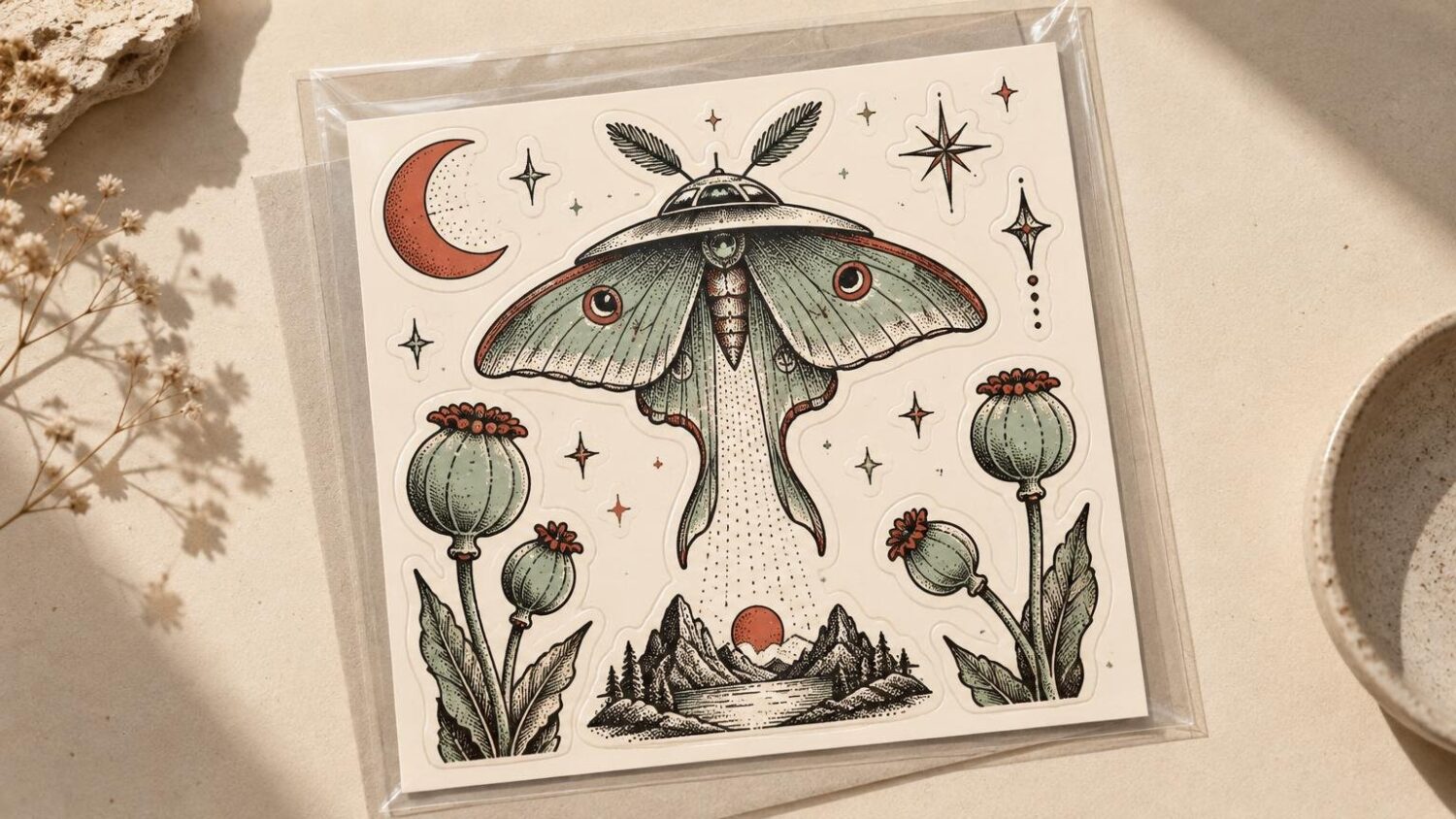
When someone rarely peels a sticker, do not buy as though the adhesive is the whole point. Buy a small printed artwork with its display surface already attached. A composed sheet suits the collector who frames complete arrangements, a coordinated pair suits the person who likes compact visual conversations, and an illustrated backing card suits the archivist who values edition details.
The useful question is not, “Where will they stick it?” Ask, “How will they keep it?” Look at the overall display size, whether the artist is clearly credited and whether the package can remain part of the presentation without covering the art.
For the collector who frames the whole sheet
Choose a composed sheet for the recipient whose collection lives in small frames, portfolio sleeves or flat drawers. The strongest sheets work as finished compositions: the gaps between stickers feel deliberate, colors recur across the page and no single design makes the rest look like leftovers.
The Lina Condes Sticker Sheet is a useful current example. Wynwood Walls Shop listed it at $12.95 with an Add to cart control when captured. The glossy-vinyl A5 sheet measures 5.8 × 8.3 inches and holds six die-cut holographic designs. Artist information, social handles and official branding appear on the reverse. At that size, the buyer can judge it as a complete display rather than six unrelated peelable objects.
A5 is large enough to read as a small print on a shelf, yet compact enough for a document sleeve. Before buying, compare the stated dimensions with a frame or display stand the recipient already uses. Pay attention to artwork near the sheet edge as well: a narrow outer margin can feel cramped once a frame lip overlaps it.
For this recipient, reverse-side credit is helpful but should not be the only attribution included with the gift. Keep the product card or add a small note naming the artist, title and seller. Once the sheet is framed, its reverse may be difficult to inspect.
For the collector who prefers a coordinated pair
A pair is the better choice for someone who arranges stickers in small clusters: two pieces beside a record player, two motifs in a trading-card sleeve or a matched set on a narrow ledge. Look for a visible relationship between the designs. They might repeat one accent color, mirror each other’s silhouettes or show two views of the same subject.
Wynwood Walls describes Kenny Scharf’s BOOM BOX Sticker Sheet as two full-color die-cut designs and identifies the artwork as officially licensed. The captured listing showed a price of $11.95, although it did not provide dimensions for the individual stickers or sheet. It also did not establish numbering, a signature or an edition size. Those omissions matter to a non-peeling collector because the package itself determines how easily the pair can be displayed.
If dimensions are missing, ask the shop before treating the pair as frame-ready. Two bold designs can still arrive on a backing sheet too small for a standard frame or too large for the recipient’s usual sleeves. A mockup without measurements cannot settle that question.
A custom pair can also make a thoughtful gift when you own the artwork or have permission to reproduce it. CustomStickers custom stickers, vinyl materials, and artwork preparation can support that kind of commissioned project. Keep the two pieces visibly related and order a physical sample before committing to a larger set; the checklist for checking an artist sticker sample covers linework, color, cut edge, finish and small-scale readability.
For the archivist who keeps every card
Choose an illustrated backing card for the collector who records artists, editions and purchase details. Here, the card is not disposable packaging. It establishes the display boundary, protects the sticker from loose handling and gives attribution a permanent home.
The Shapes In Nature Artist Signature Series presents each sticker on a 4 × 6 inch card printed with a corresponding image. The maker describes the editions as signed and hand-numbered, with tier ranges of 1–19, 20–30 or 50–80. When captured, several Black Edition items were displayed at $4 while other individual editions were marked out of stock. A standard 4 × 6 format is especially convenient for photo sleeves, small frames and archival boxes.
This format rewards close inspection. Check whether the signature and number are physically on the card rather than shown only in a product-page image. Make sure the sticker does not obscure the artist’s name, and look for enough quiet space around both the printed image and the sticker. Dense packaging can make a small edition feel like retail inventory rather than a considered art object.
For a larger presentation, the Pérez Art Museum Miami Dominic Chambers sticker set paired a 7 × 7 inch sticker sheet with a same-size mini print and information card. The sets were hand-numbered in editions of 400, but the captured listing was sold out. It remains a useful model for presentation: artwork, display print and documentation share one consistent footprint.
Check the package as carefully as the sticker
Artist credit should be readable without searching for the original listing. Ideally, the package names the artist and artwork and preserves any licensing, edition or publisher information supplied by the seller. Do not assume that a holographic finish, signature or number makes an item limited; edition status requires an explicit statement from the artist or publisher.
Finally, match the footprint to the recipient. Give the frame-minded collector a composed sheet, the visual arranger a coordinated pair and the edition keeper an illustrated card with durable attribution. The best sticker gift for someone who never peels it already looks complete before the adhesive is exposed.