
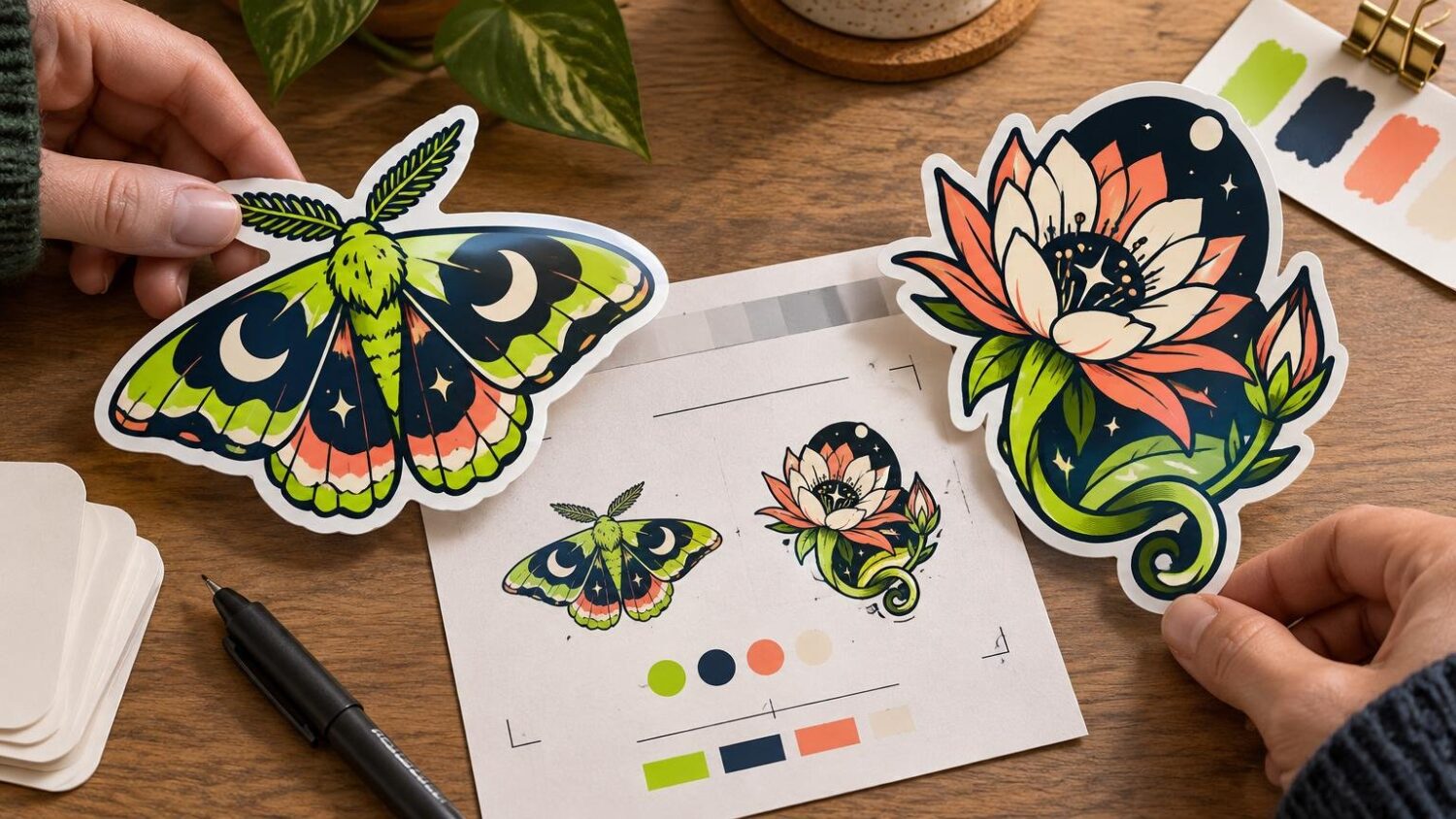
A moth and a night-blooming flower make a natural sticker pair: one seeks the other, and their silhouettes can lean toward each other without becoming one drawing. Start the collaboration by agreeing on that relationship. Then give both illustrators the same finished size, palette, border approach and proof deadline. These limits create a pair while leaving each artist’s linework intact.
The most useful first decision is whether the project will become two separate die-cut stickers or one sticker sheet. Two die cuts give each illustration its own silhouette. A sheet can present the moth, flower and smaller connecting details as one composition, with room for a title and artist signatures. Sticker Saucer treats a sheet as one complete layout containing multiple peelable stickers, and the surrounding space can carry a title or credit.
Write a one-page collaboration brief
Keep the brief short enough that both artists will actually use it. Name the subject of each sticker, the shared visual rules and the files each person must deliver. For this pair, the moth might carry the darkest shapes and the flower might carry the brightest color. A repeated crescent, dot pattern or leaf curve can connect them.
- Artist A draws the moth; Artist B draws the night-blooming flower.
- Both stickers use the same finished size and border treatment.
- The pair shares one dominant color and two or three supporting colors.
- Each design includes one repeated detail, such as a pale crescent or acid-green pollen dot.
- The artwork must remain readable when viewed at its intended print size.
- Each artist reviews the combined proof as well as their own sticker.
- The final presentation includes both names in an agreed order.
Set the size before either artist moves from sketch to final lines. A moth built around feathery antennae needs enough separation between the smallest marks. A flower with layered stamens can become a knot when reduced. Print an early paper mockup at finished size and use the two-inch sticker check to identify lines that need opening, thickening or removal.
Build one palette, not two neighboring palettes
Choose color by role. For example, use deep blue-black for the moth’s major shapes, moonlit cream for the flower, violet as a shared middle color and #91FF00 for a small pollen or eye accent. Each artist can distribute those colors differently, but the same named swatches should appear in both files.
A shared color library reduces accidental variations between files. Adobe’s Creative Cloud Libraries guidance explains how collaborators can receive view or edit access to a library containing shared assets; libraries can hold colors, color themes, graphics, styles and text. Use clear names such as “Petal Cream” and “Moth Black” rather than leaving both artists to choose from several nearly identical swatches.
Agree on line behavior as well as color. The moth may use a bold outer contour with fine wing marks, while the flower uses the same outer weight and softer interior veins. That shared outer edge will do more to unite the pair than forcing both illustrators to mimic each other’s hand.
Choose the format before arranging the proof
For separate stickers, place the moth and flower beside each other on a review sheet at actual size. Include their dimensions, finish, artist names and a small grayscale view. Sticker Saucer’s vinyl sticker option can include multiple designs in one order when those designs share the same size and options; available choices include artwork-following die cuts and matte or gloss finishes on white vinyl. Review the vinyl sticker format before locking the brief.
For a sticker sheet, compose the entire backing area as one piece. Leave breathing room between the peelable moth and flower, then use an unpeeled area for the collaboration title and credit line. A quantity of sticker sheets means that many copies of the complete layout, rather than a combined count of all the small stickers on it. Different layouts are separate batches.
A holographic treatment can suit the nocturnal theme, but assign it a job. It could show through in the moth’s eyes, a thin moon or the flower’s pollen rather than competing with every line. Sticker Saucer’s holographic material creates a shifting rainbow reflection, and order notes can identify the areas intended to reveal that material. For a more detailed approach, see how to choose where holographic material shows through.
Make one proof sheet that both artists approve
The proof sheet is the meeting place for the collaboration. Show both stickers at finished size, not only as enlarged artwork. Add a close view for inspection, but keep the actual-size pair prominent. Sticker Saucer recommends checking a proof at the intended print size, holding it at arm’s length and preserving enough space between fine details for them to remain distinct.
- Check the pair first. Do the moth and flower feel related without looking as if one artist corrected the other?
- Check each silhouette. The moth’s antennae and the flower’s outer petals should read cleanly.
- Inspect the smallest gaps. Open any wing marks, stamens or leaf veins that merge at finished size.
- Compare the shared swatches and border treatment across both files.
- Read the title and both artist credits at actual size.
- Record approval from each artist for artwork, arrangement, finish and credit.
Agree on credit, ownership and use before release
Give credit a physical location in the design plan. A sticker sheet can carry “Moth by [Artist A] · Flower by [Artist B]” beneath the title. Separate die cuts may need a shared backing card, product description or other presentation space. Confirm spelling, name order and social handles before the proof is approved.
The artists should also put their ownership and permission terms in writing. Cover who may reproduce each drawing, whether the paired arrangement can be reused, who can approve another print run, how income and expenses are divided, and what happens to unsold pieces. The U.S. Copyright Office Compendium explains that contributions intended to merge into inseparable or interdependent parts may form a joint work, while separate contributions to a collective work can be treated differently unless rights are transferred. The project agreement should state the collaborators’ intent rather than leaving that question to the artwork’s layout.
Send one complete project package
Before ordering, collect the final moth file, flower file, combined proof, palette, dimensions, finish choice, credit text and both approvals in one folder. Use filenames with version numbers so an early flower sketch cannot replace the approved drawing.
For a custom-project question, contact Sticker Saucer with the intended size, quantity, application location, artwork and the detail the finish should emphasize. Collaboration inquiries can also include portfolio links or sketches and a description of what the artists want to make. Send the project details to Sticker Saucer once both illustrators have approved the same package.
A good collaboration does not erase the seam between two drawing styles. It makes that seam intentional. Let the moth keep its feathery line, let the flower keep its open wash or crisp petals, and connect them through size, color, repeated shapes and a proof that both artists sign off together.
Frequently Asked Questions
Should the collaboration use two die-cut stickers or one sticker sheet?
Choose two die cuts when each illustration needs its own silhouette. Choose a sheet when the moth, flower, connecting details, title and artist credits should share one complete layout.
What should the collaboration brief include?
Name each artist’s subject, the finished size, border treatment, shared palette, repeated visual detail, required files, proof deadline and credit order.
How can both artists keep their own drawing style?
Unite the pair through size, outer line weight, color and a repeated shape. Let each illustrator keep their own interior marks, textures and handling of the subject.
How should the artwork be checked at sticker size?
Print a paper mockup at the intended size. Check whether the moth’s antennae, wing marks, flower stamens and leaf veins remain separate and readable rather than judging only enlarged artwork.
What belongs on the shared proof sheet?
Show the complete pair at finished size, close views for inspection, dimensions, finish, shared swatches, border treatment, title and both artist credits. Sticker Saucer recommends reviewing proofs at intended print size and leaving enough space between fine details.
How should both illustrators approve the final pair?
Record approval by artist, decision and exact file version. If either drawing, arrangement, finish or credit changes, return the revised pair to both artists for another sign-off.
Where should both artists receive credit?
A sticker sheet can place both names in the surrounding unpeeled area. Separate die cuts can use a shared backing card, product description or another agreed presentation space. Confirm spelling and name order before approval.
What ownership terms should the artists settle before release?
Put reproduction rights, reuse of the paired arrangement, reprint approval, income and expense division, and treatment of unsold pieces in writing. The collaborators should also state whether they intend a joint work or separate contributions.